
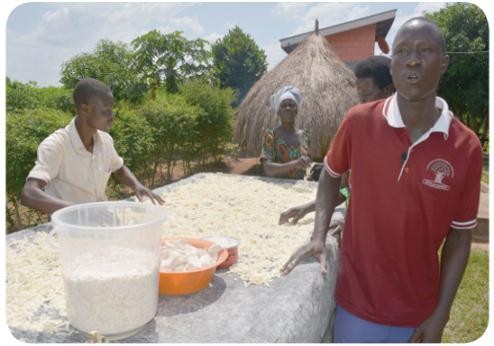
In 2022, the project mobilized members from Avogera village under the leadership of their charismatic leader called Pimungu Rogers. Mr. Pimungu happens to be the Group’s Secretary General. According the Sec. General, the AgSS project gave out a cassava chipping machine, 15 drying rakes, and 5 tarpaulin to Dikiri Kello Bero.
“We also received cereals and cassava stems as planting material. Our traditional cassava would take 2 years to mature while the improved one takes only 8 months to harvest, and it is very tasty. We were also using poor post-harvest methods like drying cassava on the ground, hence sometimes our cassava would become toxic and dirty. Planting cassava stems vertically would attract termites that would eventually eat up the stems”. Group members pointed out other problems like: poor crop spacing, mixing cropping, which would result into poor yields. “With the agriculture support services, we are now practicing horizontal cassava farming, among other good practices. The project has united us as group members, and we are now cooperative than never before! We have so far supplied 242 bags of cassava, and hence earned 4.84 million. We have resolved to start hiring out our Post-Harvest Handling Equipment (PHH) to generate more income for the group”.
“I was frustrated because my land for cultivation was taken before this project,” Stella said. Afoyocan. Stella, a 50-year-old Kisomere village resident with a family of 20 dependents, was one of the people impacted by the oil and gas activity. Compensation was given for the removal of her one-acre rental property that contained trees and food crops (Cassava, Sorghum, maize, and G. nuts). She purchased 10 acres of property, built a house, and paid for her children’s tuition. My life is now a testament to LEU’s arrival with the AgSS initiative. We received agro-inputs (Cassava, Maize, G. nuts) and extension services, such as instruction in effective agricultural methods, “Another group member said”.